Lacora L-40: Repair and 230V conversion
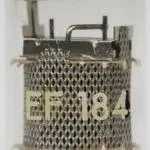 EF184
EF184
The Lacora L-40 radio was a relatively popular low-cost model in 1950s Spain. Thanks to its small, compact size, light weight, and relatively low price, many units were sold. Lacora…

Circuits, hardware, and classical computing.
The Lacora L-40 radio was a relatively popular low-cost model in 1950s Spain. Thanks to its small, compact size, light weight, and relatively low price, many units were sold. Lacora…
Once again, another Optimus amplifier has fallen into my hands, and this one will be the first I actually own, since unlike other Optimus models, this one was given to…
A few days ago, I was given a French radio from the second half of the 1940s, with the peculiarity that it came completely disassembled—every piece separated. Faced with that…
Once I had tested the tubes (and while waiting to get new ones to replace those that were completely dead, as I showed in the first part), I went ahead…
This small amplifier project began thanks to a blog reader, Sergio, who contacted me via email to see if I could help him design a small guitar practice amp using…
Continuing with the restoration of the television, the first step I take is to check some of its valves using the μTracer3+: EF183 valve: As can be seen in the…
This TV came into my hands through a local online ad — I saw it at a good price and immediately thought it had to be mine. A valve (tube)…
For a long time now, I’ve been wanting to have a tube tester—something I’ve never owned—and also a vacuum tube curve tracer, since both would be incredibly useful for me.…
After building the previous FM valve receiver, I recently constructed another one based on it—this time deviating a bit from the original design… using P-series television tubes, the kind that…
Here is my latest build: a vacuum tube FM superheterodyne receiver.This project was born out of frustration with medium wave (AM) broadcasting: the constant parasitic noise, the lack of stations,…